
AI for procurement is most useful when it moves a purchase through defined controls, not when it simply answers buying questions. A workable sequence is intake, policy review, sourcing, purchase order, goods receipt, and invoice matching. Each handoff needs evidence, an accountable owner, and a clear rule for stopping.
This runbook is for procurement managers, finance teams, and operations leaders designing that sequence. It focuses on purchasing decisions and transaction integrity rather than demand forecasting. For the wider operational picture, see AI in supply chain management.
In brief: Use AI to interpret documents and prepare decisions. Use approved rules and system permissions to control commitments. Preserve the distinction between a request, an order, a receipt, and an invoice. Pilot one bounded workflow before granting write access, and measure control failures alongside processing time.
1. Start AI for procurement with structured intake
For a team documenting intake in Indonesian, the guide to AI-assisted SOP preparation is a useful companion. The broader business AI implementation guide can help distinguish a bounded procurement trial from a company-wide rollout.
Start by converting buying requests into complete, reviewable records. AI can interpret free-text descriptions and attachments, but it should ask for missing information rather than invent specifications, delivery dates, or business justification. The output is a purchase requisition, or PR, that an authorized person can evaluate.
Require the business purpose, requested item or service, quantity, delivery location, need-by date, budget owner, and supporting documents. Capture the relevant legal entity and cost center too. Link attachments to a stable request identifier so later decisions can be traced back to the original evidence.
Keep extracted facts separate from suggestions. A quantity copied from a quote is different from a quantity inferred from an email. Show the source passage, flag conflicts between documents, and return incomplete requests to the request owner. Do not let a fluent summary hide uncertainty.
Intake completion is not purchasing approval. The next stage determines whether the request follows policy and which approval route applies.
2. Apply policy through a controlled spend taxonomy
A taxonomy is not a model-generated policy. Compare intelligent automation with business uses of large language models when deciding which steps interpret text and which enforce an approved rule. Keep the authority matrix outside unrestricted model editing.
Policy review should map the request to an approved spend category, then apply the rules for that category, entity, and value band. AI may suggest the classification, but a maintained taxonomy and versioned policy register must determine the purchasing route. Ambiguous classification belongs in review.
A taxonomy needs usable definitions, not just category labels. Distinguish goods from services, capital from operating purchases where relevant, and contracted from noncontracted spend. Assign an owner to resolve category disputes and retain the mapping used for each decision. Otherwise, reporting and approvals can change with wording.
Configure checks for budget availability, required competition, preferred suppliers, restricted categories, and delegated approval authority. These are organizational rules, not universal thresholds. A technical confidence score must never substitute for a budget check or an approver’s authority.
Save the policy version and the reason each check passed or failed. If a policy document and an ERP configuration conflict, stop for the policy owner. Do not allow the model to choose whichever interpretation permits the transaction.
3. Source against approved suppliers and contract evidence
Sourcing assistance should compare eligible offers against a documented requirement and current contract terms. AI can extract quote lines, identify missing information, and prepare a comparison. Procurement retains responsibility for supplier eligibility, evaluation criteria, negotiations, and the final award decision.
Use the supplier master as the identity reference. Similar names do not establish that two records represent the same legal entity. Confirm approved status, relevant onboarding checks, and whether the supplier is authorized for the category and entity. Proposed suppliers should follow a separate onboarding workflow.
Retrieve the effective contract version, applicable rate card, purchasing entity, service scope, and renewal or expiry conditions. A plausible clause summary is insufficient without the underlying document reference. When quotes use different units, delivery terms, or service assumptions, show those differences before ranking offers.
Record why the selected supplier meets the requirement, including any approved departure from the preferred route. Negotiation recommendations should not become commitments merely because an agent can send messages or modify a sourcing record.
4. Create the purchase order only after approval
A purchase order, or PO, should be created from approved requisition data and the accepted commercial basis. AI may prepare the order, but release requires the configured approvals and a final validation of supplier, entity, quantities, terms, and delivery instructions. A PR is not a supplier-facing order.
Keep approved values locked unless a controlled amendment reopens the relevant checks. An agent that changes the supplier, category, or quantity after approval can invalidate the decision it relies on. Revalidate material changes instead of quietly carrying forward the original authorization.
Integration design matters here. Use stable transaction identifiers, duplicate checks, and idempotent writes so retries do not create multiple orders. Log the submitted payload and the ERP response, then confirm the resulting order state before marking the step successful.
If order creation fails, keep the request in a visible pending state. Never tell a supplier that an order exists based only on generated text or an unconfirmed API call.
5. Record goods receipt from delivery evidence
Receipt confirmation must reflect what arrived or what service was accepted. AI can extract delivery-note details and suggest the relevant order lines, but an accountable receiver confirms quantities and condition. An invoice, shipping notice, or supplier promise alone does not prove that the organization received the purchase.
Record partial deliveries, rejected items, returns, and outstanding quantities against the correct PO lines. Preserve units of measure so packs are not confused with individual items. For services, define the permitted acceptance evidence and service-entry process with finance before enabling invoice processing.
Keep receipt authority separate from purchasing and invoice approval where required by the control design. If no authorized person can establish receipt, route the transaction for resolution. Do not create a receipt merely to make an invoice pass.
6. Match the invoice to the PO and goods receipt
Duplicate and suspicious transactions need their own controls. The Indonesian discussion of AI-assisted fraud detection is an adjacent reading, not permission to block a supplier solely on a model score. When outputs feed reports, use financial reporting automation only after the ledger has been reconciled.
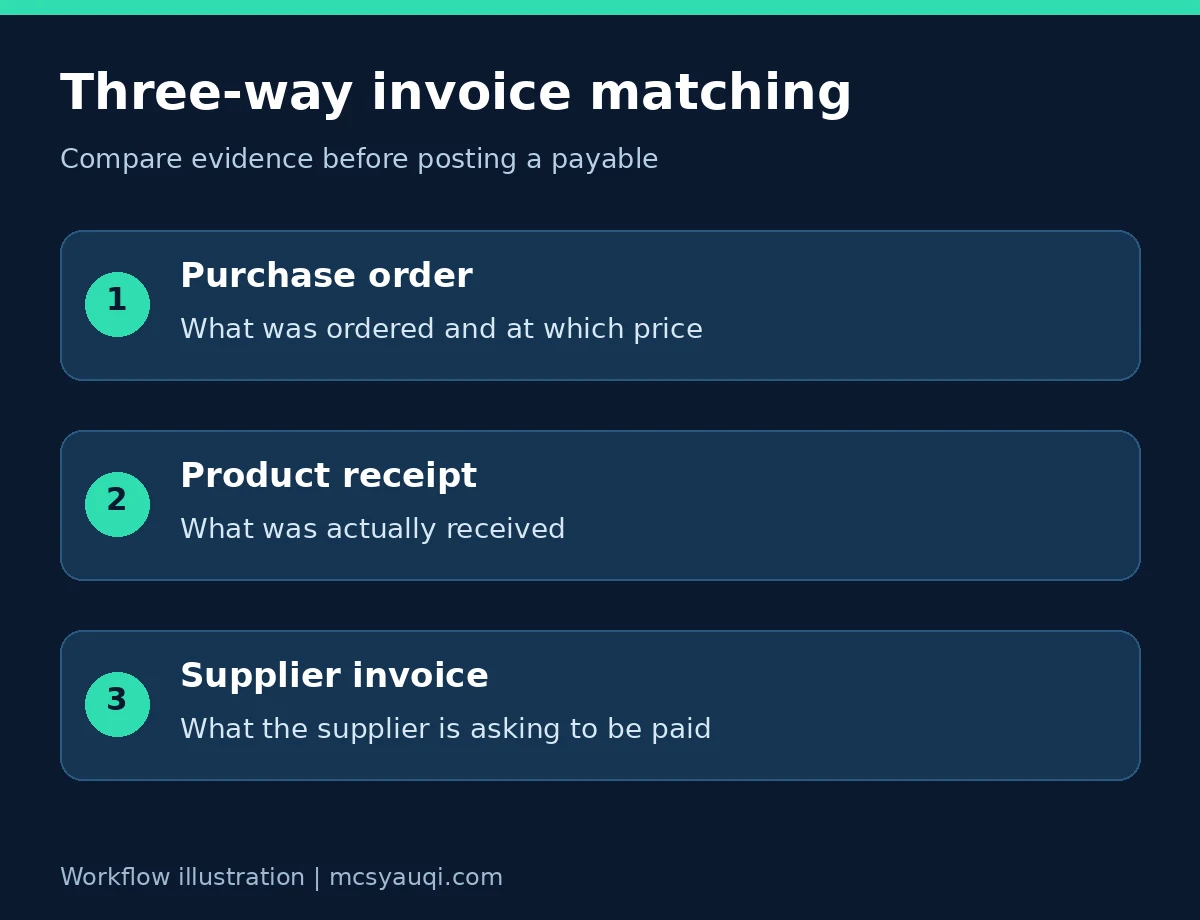
Three-way matching compares the supplier invoice, purchase order, and goods receipt or product receipt. The purchase requisition is not the third matching document. Microsoft documents this distinction in its accounts payable invoice matching overview: invoice prices are checked against the order, while invoiced quantities are checked against product receipts.
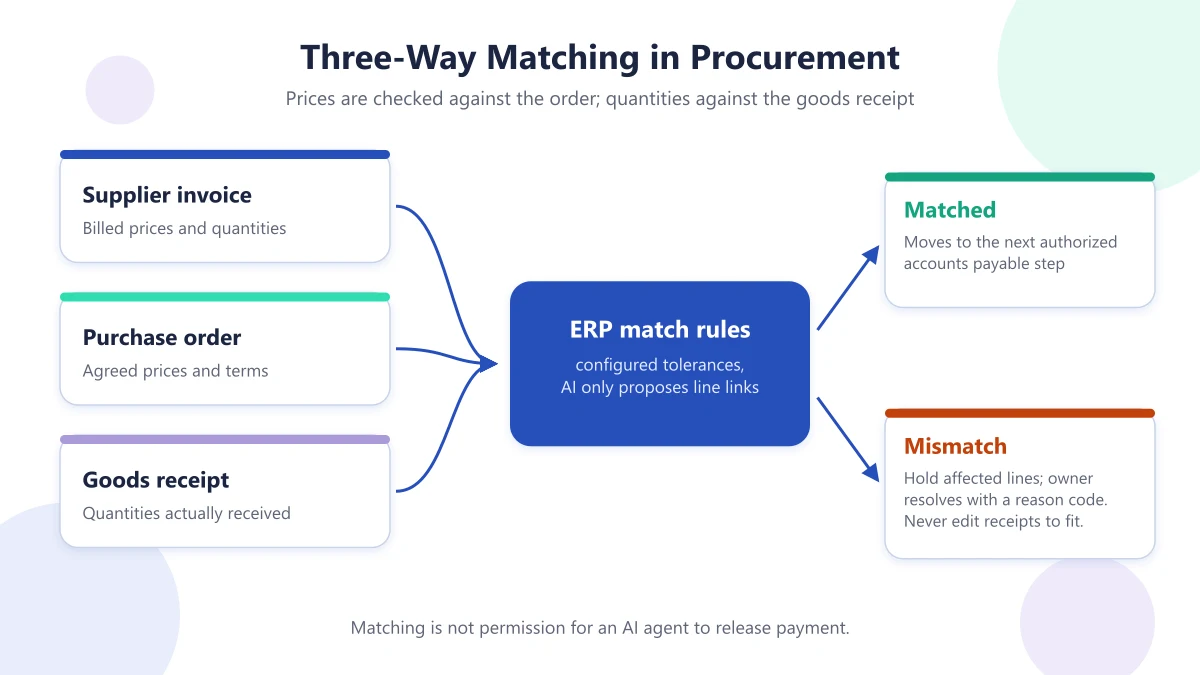
Use AI to extract invoice fields and propose line associations. Apply the actual match through configured ERP rules and tolerances. Check supplier identity, invoice reference, currency, units, charges, and relevant tax fields. Duplicate-invoice screening is an additional control, not a replacement for matching.
For example, an invoice may reference the right order while including goods not yet received. The request and PO can both be approved, yet the receipt evidence still fails. Hold the affected lines and ask the receiving team to confirm the delivery status. Do not edit receipt quantities to remove the discrepancy.
Account for partial receipts, earlier invoices, credit notes, and returns when determining what remains available to match. Configure exceptions explicitly for categories using different approved processes. A matched invoice may proceed to the next authorized accounts payable step; matching itself is not permission for an AI agent to release payment.
7. Make exceptions, access, and approvals explicit
Use AI risk management to structure escalation criteria. A model may surface a discrepancy, but the procurement and finance owners still decide how it is resolved and what evidence authorizes the next transition.
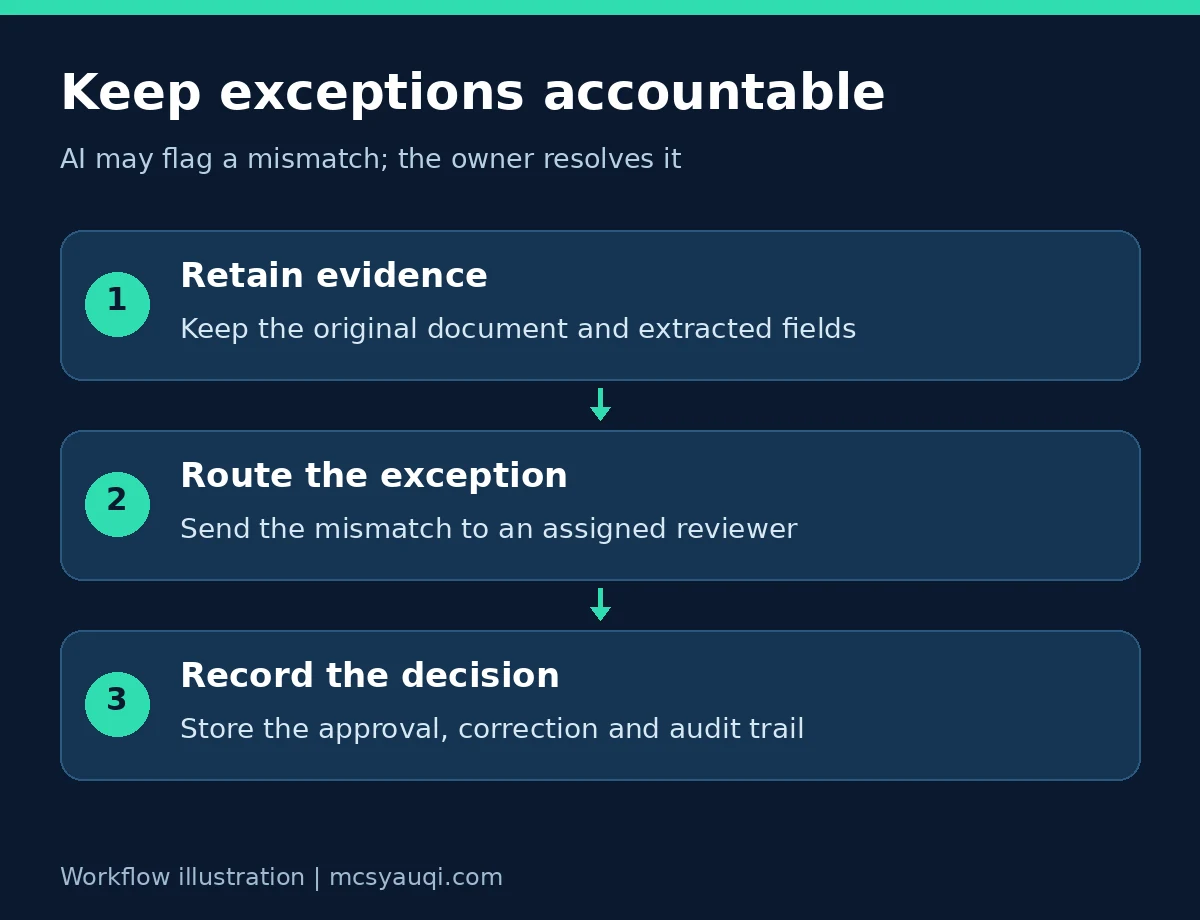
Exceptions need named owners, reason codes, evidence requirements, and escalation deadlines. An AI assistant can explain a mismatch and prepare a resolution task, but it must not waive policy. Keep the distinction between fixing bad data, granting an authorized exception, and approving a commercial decision.
Route category disputes to procurement, receipt disputes to the receiving owner, contract ambiguity to the contract owner, and invoice discrepancies to accounts payable. Record who approved each override, its scope, and its expiry where applicable. Review recurring exceptions for process defects rather than automatically normalizing them.
Give integrations the minimum permissions required. Separate document retrieval, transaction creation, approval, supplier maintenance, and payment rights. Keep supplier bank-detail changes outside autonomous workflows and require independent verification through an approved process. Restrict contract visibility to authorized users.
Treat text inside quotes, invoices, and attachments as untrusted input. A supplier document must not instruct the agent to ignore policy or reveal other suppliers’ terms. Preserve access checks during retrieval and record both system actions and human interventions.
| Exception | Owner | Evidence to request | Safe next action |
|---|---|---|---|
| Category dispute | Procurement | Spend taxonomy definition and the original request | Hold the requisition until the category is confirmed |
| Receipt dispute | Receiving owner | Delivery note and inspection record | Hold affected invoice lines; never edit receipt quantities to fit |
| Contract ambiguity | Contract owner | Effective contract version and rate card | Pause the affected order or invoice line pending clarification |
| Invoice discrepancy | Accounts payable | Invoice, purchase order, and goods receipt lines | Apply configured match tolerances or reject the line |
| Policy override request | Authorized approver | Scope, reason, and expiry of the override | Record who approved it; the AI assistant never waives policy |
8. What the SUEZ implementation actually demonstrates
SUEZ provides a concrete example of AI handling requisition checks inside an existing procurement platform. According to Pactum’s SUEZ case study, its UK operations worked with almost 3,800 suppliers and annual goods-and-services spend exceeding £700 million. Every purchase requisition previously required manual review.
Pactum reports that its Alignment Agent connects directly to Coupa and checks requisitions against SUEZ policies. The described checks include category matching, quote validation, and rate-card compliance, with an attached audit trail. The vendor says checks that could previously take days are completed in minutes.
This is vendor-reported implementation context, not an independently verified performance benchmark or a guarantee for another organization. It supports the narrower proposition that requisition validation can operate within an established purchasing system. It does not establish that SUEZ automated the entire intake-to-payment lifecycle.
The practical lesson is to select a specific control bottleneck and retain the transaction platform. Validate local policies, data quality, and exception handling before assuming the same outcome elsewhere.
9. Pilot a bounded workflow and test vendors against it
Begin with one category, legal entity, and clearly defined decision boundary. Run the assistant in shadow mode against human review before permitting operational writes. A successful pilot must demonstrate that the workflow stops safely when evidence is missing, permissions are insufficient, or policy is not satisfied.
Set explicit limits on eligible suppliers, transaction value, document types, and allowed actions. Exclude autonomous payments, bank changes, supplier creation, policy overrides, and unsigned contract commitments. Name the person who can disable the integration and test that fallback before launch.
Measure intake completeness, classification corrections, missed policy violations, unnecessary escalations, exception age, and processing time. Compare like-for-like requests and include human review effort. A faster queue is not an improvement if incomplete requests pass unchecked. Agree acceptance criteria with procurement, finance, and security before evaluating results.
Ask each vendor to demonstrate your actual edge cases:
- Can it cite the policy and contract version behind a recommendation?
- Does it distinguish a PR, PO, receipt, and invoice during partial deliveries?
- Can administrators restrict actions by role, entity, category, and transaction state?
- Do retries, outages, and revoked access fail without duplicate commitments?
- Can your team export decision logs, review data retention, and disable model training on confidential documents?
For implementation planning, connect this control map to the wider business process automation guide. An AI automation scoping discussion should start with evidence and permissions, not autonomous buying promises. An Indonesian procurement guide is available separately.
Frequently asked questions about AI for procurement
AI can assist across purchasing, but each action must remain tied to its evidence and approval boundary. These answers clarify where automation fits and which controls should stay in place.
What does AI for procurement actually automate?
AI for procurement can classify requests, extract quote details, retrieve contract terms, and recommend exception routes. Connected workflows can also prepare purchase orders and invoice checks. Approval authority should remain explicit: generating a recommendation does not authorize a supplier award, a commitment, a receipt confirmation, or a payment.
Which documents belong in procurement three-way matching?
Three-way matching compares the supplier invoice, purchase order, and goods receipt or product receipt. It checks invoice prices against the order and invoiced quantities against recorded receipts. A purchase requisition starts the internal buying request but is not the third matching document. Differences follow approved tolerance and exception rules.
Can a small procurement team start without replacing its ERP?
Yes, if its existing systems can provide controlled access to requests, supplier records, contracts, and transaction status. Start with a narrow, read-only assistant or shadow review. Test whether the integration preserves permissions, record identifiers, and approval history before allowing it to create or change operational transactions.
What should stay outside an initial procurement AI pilot?
Exclude autonomous payments, supplier bank-detail changes, unrestricted supplier creation, and policy overrides. Also exclude categories with unclear receipt evidence or unresolved compliance requirements. Keep contract commitments and approval changes under human control. Expand only after measured tests show that missing evidence and policy violations reliably stop the workflow.
Can AI approve purchase orders on its own?
It should not. AI can prepare a purchase order from approved requisition data, but release requires the configured approvals and a final validation of supplier, entity, quantities, terms, and delivery instructions. If the supplier, category, or quantity changes after approval, the relevant checks must be reopened rather than carried forward.
How does AI help with supplier quotes during sourcing?
AI can extract quote lines, identify missing information, and prepare a comparison against a documented requirement and current contract terms. Procurement remains responsible for supplier eligibility, evaluation criteria, negotiation, and the award decision. Similar supplier names should be checked against the supplier master, because they do not prove the same legal entity.
What happens when an invoice does not match the goods receipt?
Hold the affected invoice lines and ask the receiving team to confirm the delivery status. Do not edit receipt quantities to make the mismatch disappear. Account for partial receipts, earlier invoices, credit notes, and returns before deciding what remains available to match, and record a reason code for the exception.
How should a procurement team evaluate an AI pilot?
Run the assistant in shadow mode against human review first, then compare request completeness, corrections to suggested categories, policy violations that were caught or missed, and exception handling effort. A pilot passes only if the workflow also stops safely when evidence is missing, permissions are insufficient, or policy is not satisfied.