

AI supply chain management uses predictive models, optimization, and automation to help teams plan demand, position inventory, and respond to disruption. Its value depends on whether recommendations improve operational decisions, not whether a dashboard looks intelligent. A useful implementation connects a defined business decision to reliable data, operational constraints, and an accountable owner.
This guide explains how to build that connection. It separates forecasting from optimization, examines Lenovo’s reported iChain results, and outlines an implementation path that preserves purchasing and fulfillment controls. The recommendations below are implementation guidance, not claims of client results or guaranteed savings.
TL;DR: Start with a bounded planning decision. Treat forecasts as uncertain inputs, enforce inventory and supplier constraints, and integrate through approval workflows. Evaluate service, cost, and planner workload together. Expand automation only after historical testing and a controlled operational pilot show that recommendations remain useful and safe.
What decisions should AI supply chain management control?
AI should initially recommend actions within explicit decision boundaries, while people retain approval over material commitments. Define which products, locations, planning horizons, and transaction types are eligible. Document what the system can suggest, what it can execute, and which conditions force escalation to a named decision owner.
For replenishment, a useful output is a proposed order quantity with its demand assumptions, expected arrival, inventory position, and binding constraints. The proposal should explain why ordering now is preferable to waiting. A planner must be able to inspect the underlying records rather than accept a persuasive narrative.
- Advisory: Flag a projected shortage and explain the evidence.
- Approval required: Draft an inventory transfer or purchase request.
- Restricted execution: Release an approved action only when policy checks pass.
- Escalation: Stop when supplier capacity, compliance, or critical data is unresolved.
Separate recommendation quality from permission to act. A sensible transfer can still be unauthorized if it crosses a contractual boundary. Record the applicable policy version alongside every recommendation so a later review can reconstruct the decision.
How do forecasting and optimization differ?
Forecasting estimates what could happen; optimization chooses an action under constraints. A demand forecast predicts likely demand and its uncertainty. An optimizer uses those estimates alongside stock, lead times, capacity, and costs to propose replenishment or allocation. Neither function should be confused with a language model explaining the result.
Keep these components separate in the implementation. Store the forecast and uncertainty range as structured outputs. Pass them into a constraint-aware planning routine. Use a language model, if needed, to summarize approved evidence or extract disruption details from documents, with source references and validation.
Analytical insight: A more accurate forecast can produce a worse inventory decision when the planning objective is wrong. Optimizing average forecast error may neglect expensive shortages on critical items. Evaluate the resulting allocation or order policy, not just the prediction, and make the service-versus-cost tradeoff explicit.
For example, a hypothetical distributor could forecast stable aggregate demand while missing a regional shortage. Its allocation policy would still fail customers. Evaluate product-location decisions and replenishment timing, rather than assuming an accurate company-wide total proves operational usefulness.
| Component | Question it answers | Main inputs | Output | Validated by |
|---|---|---|---|---|
| Demand forecasting | What could demand look like, and how uncertain is it? | Dated demand, promotions, stockout periods | Forecast with an uncertainty range | Bias and error by product, location, and horizon |
| Optimization | What should we order or allocate under constraints? | Forecast, stock, lead times, capacity, costs | Proposed order or allocation | Service and cost against an agreed baseline |
| Language model | What do documents and approved evidence say? | Approved records, disruption notices | Summary or extracted details with sources | Checks against the cited source records |
Which supply chain data needs attention first?
Data definitions should follow the operating process. The Indonesian guide to documenting business SOPs with AI helps frame the handoffs, while AI in manufacturing provides an adjacent production context. Use these as scope references, not as evidence of a measured improvement in your plant.
Fix data that changes the decision before adding model complexity. Begin with consistent product and location identifiers, inventory status, dated demand, open orders, and observed supplier lead times. Keep event timestamps and availability timestamps distinct so historical tests do not use information that planners could not have known.
Build a decision dataset with the following fields, mapped back to authoritative operational records:
- Demand: Orders, shipments, cancellations, promotions, and stockout periods.
- Supply: Purchase orders, confirmations, receipts, partial deliveries, and supplier calendars.
- Inventory: Available, reserved, quarantined, damaged, and in-transit quantities.
- Constraints: Pack sizes, minimum orders, shelf life, storage limits, and approved substitutes.
- Economics: Holding costs, expedite costs, and agreed shortage priorities.
Shipped quantity is not always unconstrained demand. A product unavailable for sale can show low shipments despite interested customers. Flag those periods and document how the forecasting approach treats them. Otherwise, a replenishment model may interpret an availability problem as declining demand.
Assign an owner to each critical field. Reject stale stock snapshots, invalid units, and missing supplier mappings before inference. Where information is incomplete, return a visible exception instead of silently substituting a convenient assumption.
What does Lenovo’s iChain case actually demonstrate?
Lenovo’s iChain case illustrates AI-supported supply chain orchestration at enterprise scale, but its published performance figures are company-reported. In its 2026 supply chain announcement, Lenovo describes iChain as coordinating thousands of suppliers and more than 30 manufacturing sites. These are Lenovo’s stated operating conditions, not a template for every business.
Lenovo reports 60% faster decision-making and 90% automation of network simulations. The same announcement says manual analysis fell from two to three weeks to two to three hours. These figures come from Lenovo’s announcement; they are not independently audited results established by this article, nor guaranteed outcomes for another implementation.
Analytical insight: Simulation speed and business value are different measurements. Faster scenario analysis creates an opportunity to compare more feasible responses before a disruption worsens. It does not, by itself, prove better inventory placement or lower total costs. Incorrect constraints can also make a fast simulation operationally unusable.
The transferable lesson is architectural: connect planning data, scenario evaluation, and execution ownership. For a smaller organization, that might mean a shortage worklist with approved alternatives, not an enterprise-wide orchestration platform.
How should AI manage inventory risk?
For Indonesian operating examples, compare inventory planning with AI with inventory transaction automation. Forecasting a stock requirement and writing a stock movement are separate responsibilities; neither article removes the need to reconcile the warehouse record.
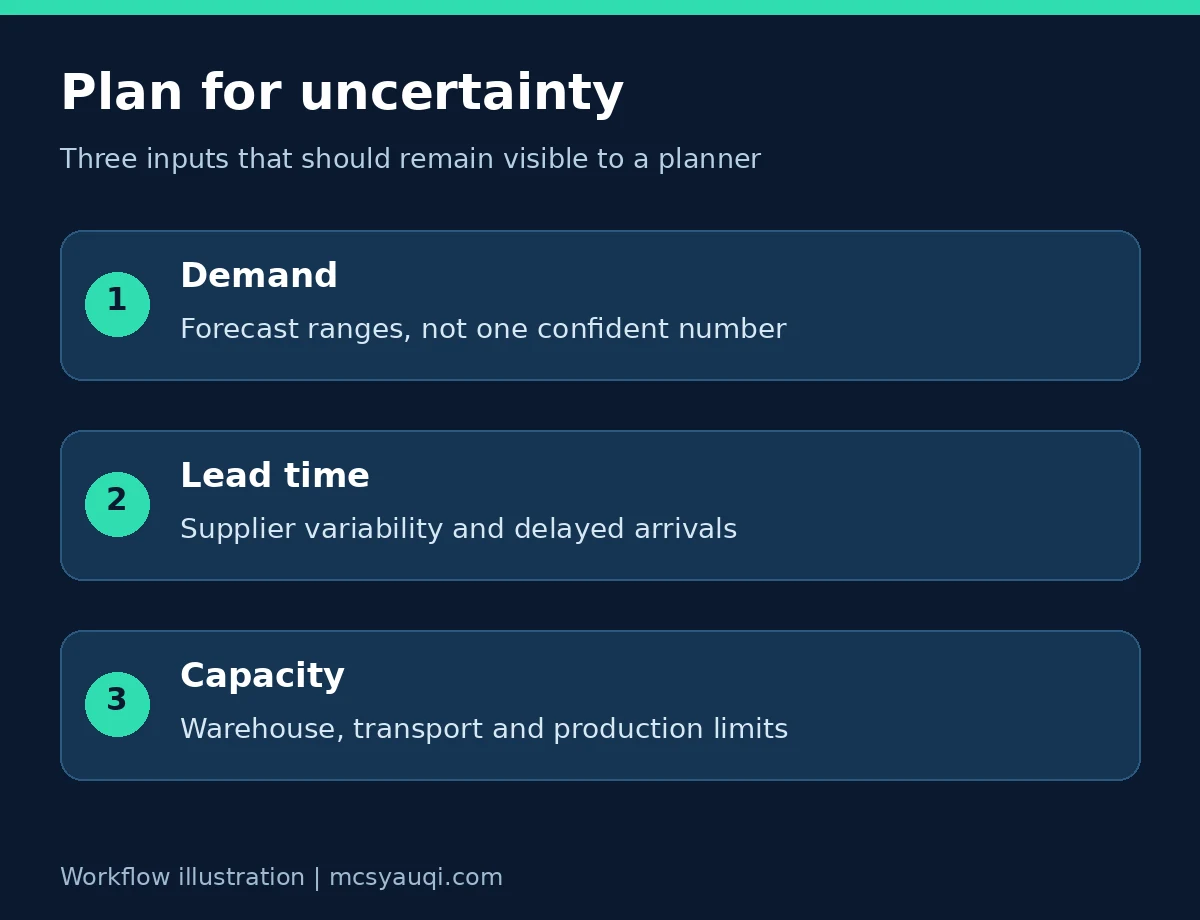
Inventory recommendations should balance shortage exposure against excess stock, using uncertainty rather than a single demand estimate. Segment items by operational importance, demand pattern, replenishment reliability, and obsolescence risk. Apply different policies where a missed sale, production stoppage, or expired product has different consequences.
For each proposed order, inspect available inventory, committed demand, expected receipts, and realistic arrival timing. Include pack sizes and minimum orders before approving a quantity. A recommendation that ignores these constraints is not executable, even when its demand estimate is reasonable.
In a hypothetical manufacturer, a delayed component might justify expediting, substitution, or production resequencing. The system should compare those alternatives using current approvals and capacity constraints. It should not automatically increase every related order, which could leave excess inventory after the disruption passes.
Ask the planning engine to show a downside scenario alongside its preferred action. What happens if the shipment slips, demand weakens, or the substitute fails approval? Define which scenario changes require human review. Keep regulated, hazardous, and customer-specific materials behind their existing controls.
How do you integrate AI with operational systems?
For delivery-stage decisions, see AI for delivery operations. For the distinction between rule-based work and model-assisted interpretation, consult intelligent automation. Assign each integration a clear system of record before allowing a recommendation to update an order.
Integrate through a controlled recommendation workflow before allowing direct writes to operational systems. Read authoritative inventory and order data from ERP, warehouse, and transport applications. Write proposals to a staging layer, validate them, and send approved transactions through supported interfaces with traceable identifiers and clear failure handling.
IBM’s supply chain solutions overview identifies partner data exchange, procurement, inventory management, visibility, orchestration, and fulfillment optimization as connected capabilities. This supports treating integration as part of the operating design, not assuming a standalone model can replace those systems.
Give every proposal a unique recommendation identifier, source-data timestamp, model version, and approval status. Before execution, recheck stock and open orders because conditions may have changed. Make retries idempotent: processing the same approved recommendation again must not create duplicate purchase orders.
Handle partial failures explicitly. If an ERP accepts an order but the acknowledgment is lost, reconcile the transaction before retrying. Preserve audit logs, restrict service-account permissions, and define how planners resume the existing workflow when the AI service is unavailable.
How should you evaluate models and business decisions?
Evaluate forecast quality, decision quality, and operational reliability separately. Use historical periods in chronological order, then compare recommendations with an agreed baseline such as the current replenishment policy. Include relevant promotions, supplier delays, and stockouts rather than selecting only easy periods that flatter the model.
- Forecast quality: Track bias and errors by product, location, and relevant planning horizon.
- Service: Measure fill rate, backorders, and shortages affecting critical demand.
- Economics: Compare inventory exposure, write-offs, and transport or expedite costs.
- Operations: Record planner review time, overrides, invalid proposals, and failed transactions.
Define each metric’s denominator and event timing before testing. An apparent service improvement is difficult to interpret if canceled orders disappear from the comparison. Similarly, a reduction in review time is not useful if staff must repair incorrect transactions elsewhere.
Run sensitivity tests for delayed receipts, missing supplier confirmations, and sudden demand changes. Review disagreement cases with planners. An override may reveal an unmodeled constraint rather than resistance to automation. Feed validated exceptions into policy and data improvements, not unreviewed model retraining.
How do you run a controlled supply chain pilot?
Review the pilot boundaries alongside AI risk management guidance in Indonesian. Record who may approve an override and which business condition stops the trial; a better average forecast should not conceal an unsafe purchasing recommendation.
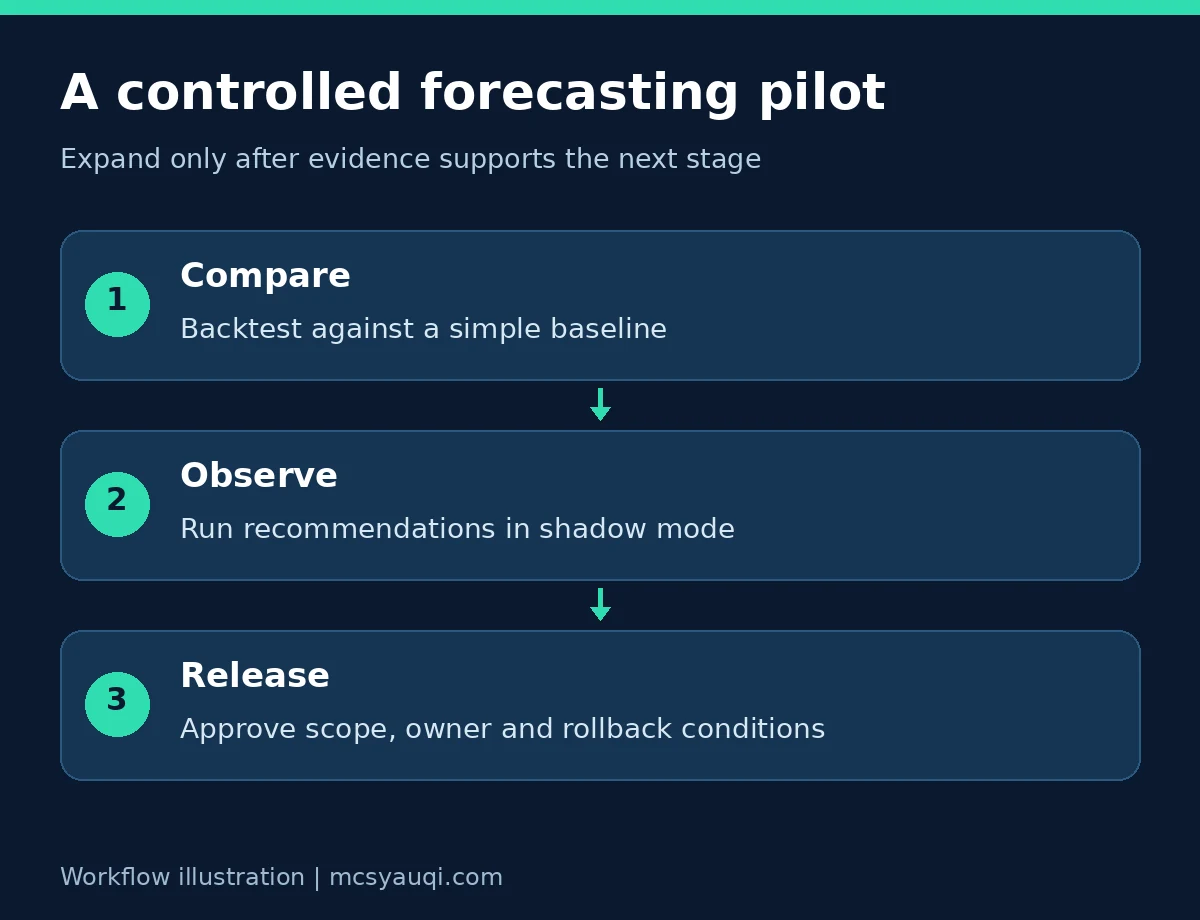
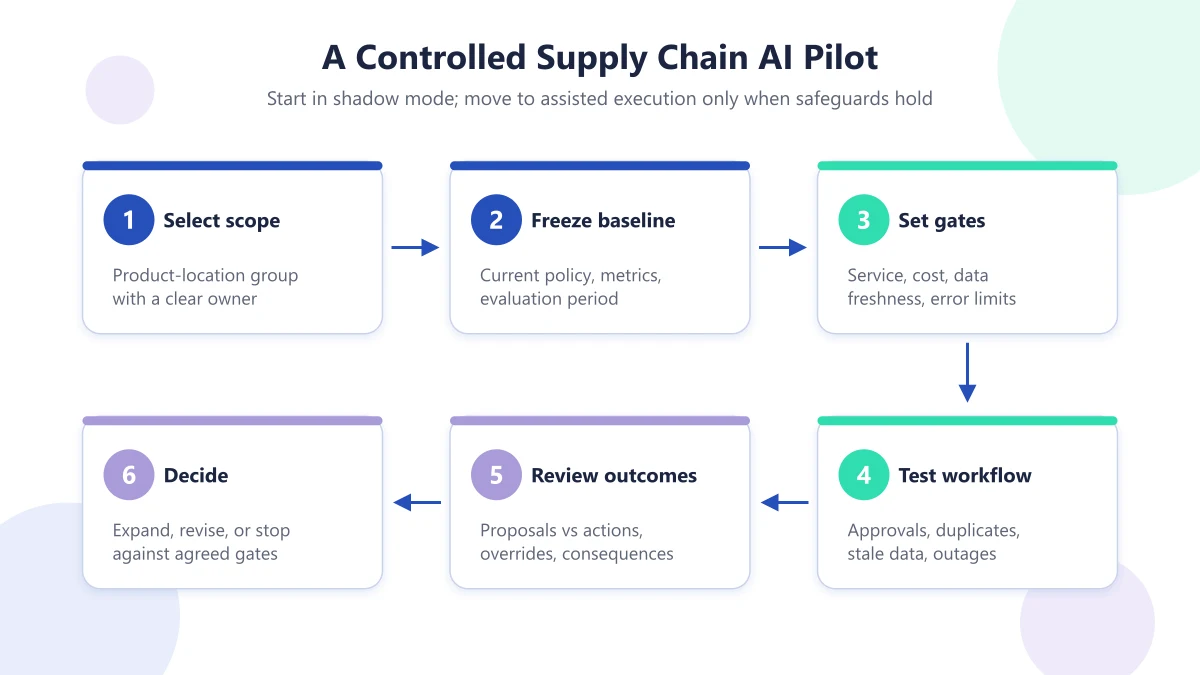
Run a pilot around a bounded decision with a baseline, accountable owner, approval policy, and rollback path. Start in shadow mode, where recommendations are recorded without changing transactions. Move into assisted execution only when planners can explain the proposals and the operational safeguards work under realistic exceptions.
- Select the scope: Choose a manageable product-location group with usable records and a clear planning owner.
- Freeze the baseline: Document the current policy, measurement definitions, and evaluation period.
- Set acceptance gates: Agree acceptable service, cost, data freshness, and error conditions before reviewing results.
- Test the workflow: Exercise approvals, duplicate prevention, stale data, and unavailable integrations.
- Review outcomes: Compare recommendations, actual actions, overrides, and operational consequences.
- Decide deliberately: Expand, revise, or stop based on the agreed gates, not demo enthusiasm.
A pilot is not complete when the model produces plausible orders. Confirm that planners can reject a proposal, explain an override, identify its data version, and return to the existing process without losing committed transactions.
Where do procurement and workflow automation fit?
Procurement and workflow automation extend the same decision loop, but they solve different problems. Procurement manages sourcing and supplier commitments; workflow automation routes information, approvals, and execution. Keep those boundaries visible so a supply recommendation does not bypass purchasing policy or create an unsupported supplier commitment.
Use the AI for procurement guide for supplier-facing decisions and the business process automation guide for approval and handoff design. For Indonesian-language context, see AI for supply chain in Indonesian.
For implementation support, review the AI and business automation service details. Bring a specific decision, sample operational records, and the current approval process. That creates a concrete starting point for scoping rather than an open-ended request to automate the whole supply chain.
Frequently asked questions
These answers summarize the practical boundaries of AI-based supply chain management. The appropriate level of automation depends on data quality, operational risk, and the ability to validate decisions.
What is AI-based supply chain management?
AI-based supply chain management applies predictive models, optimization, and automation to planning and execution decisions. Common applications include demand forecasting, replenishment proposals, disruption alerts, and allocation. A reliable implementation connects these outputs to verified operational data, explicit constraints, and approval rules instead of treating predictions as automatic instructions.
Can generative AI replace supply chain planning software?
Generative AI should not be treated as a substitute for constraint-aware planning or authoritative transaction systems. It can help extract supplier updates, summarize exceptions, and explain approved recommendations. Quantities, capacity limits, inventory balances, and purchase commitments still need validated calculations, operational records, and appropriate approval controls.
How much data is needed to start a supply chain AI pilot?
There is no universal history requirement that fits every item or planning horizon. Start by checking whether available records represent the demand patterns, replenishment behavior, and exceptions relevant to the chosen decision. If the evidence is insufficient, narrow the scope or improve data collection before claiming dependable model performance.
Does AI always reduce inventory costs?
No. Outcomes depend on the objective, constraints, data, and execution process. A policy designed to protect critical service may deliberately increase selected inventory. Evaluate holding costs alongside shortage exposure, obsolescence, and expedited transport. Vendor case studies can inform a pilot, but they do not establish guaranteed savings for another business.
What is shadow mode in a supply chain AI pilot?
In shadow mode, the system records its recommendations without changing any transactions. Planners compare those proposals with their own decisions and actual outcomes. Move to assisted execution only when planners can explain the proposals and safeguards such as approvals, duplicate prevention, and stale data checks work under realistic exceptions.
Which supply chain data should be cleaned first?
Start with data that changes the decision: consistent product and location identifiers, inventory status, dated demand, open orders, and observed supplier lead times. Keep event timestamps separate from the time data became available, so historical tests do not use information planners could not have known at that moment.
How should AI recommendations reach ERP and warehouse systems?
Through a controlled recommendation workflow. Read authoritative inventory and order data, write proposals to a staging layer, validate them, and send approved transactions through supported interfaces with traceable identifiers and clear failure handling. Direct writes to operational systems should come only after that workflow has proven reliable.
How do you know whether an AI planning model beats the current process?
Compare it with an agreed baseline, such as the current replenishment policy, over historical periods in chronological order. Evaluate forecast quality, service levels, inventory economics, and operational reliability separately. Include promotions, supplier delays, and stockouts instead of choosing easy periods that flatter the model.